Buildings That Learn With You

Woodham Academy offers students a setting that encourages focus, steady circulation and new opportunities for learning supported by the building’s intelligent systems. Its architecture carries the values of sustainability and community into every corner of the site.
Overview
Woodham Academy sits between residential streets and mature public woodlands in Newton Aycliffe, serving more than 1,200 students and acting as an anchor for the wider community. The first school in the North East to achieve Net Zero Carbon in Operation, the new building replaces outdated facilities with a calm and confident piece of architecture that supports daily school life while strengthening local connections. Woodham Academy is a school designed to support its people, enrich its place and lessen its environmental impact.
Delivered under the Department for Education's S21 framework, Woodham Academy incorporates standout features such as its biodiverse green roof, a Net Zero Carbon in Operation pool, and a signature timber entrance. A clear plan, centred on a three-storey atrium, organises over 55 teaching spaces around a bright heart. Daylight moves deep into the building, assisted by fully glazed internal screens that extend borrowed light through corridors and shared areas. Movement is effortless and intuitive. In the words of Danny Morgans, Deputy Headteacher, “Students move easily between lessons, and the whole day flows better. The building has transformed how learning happens.”
- Year 2024
- Location County Durham
- Client Department for Education
- Project Sectors Education


Design Approach
From the outset, the design team worked closely with staff and members of the leadership team. Routes, adjacencies and departmental relationships were shaped through direct dialogue, ensuring the building supports education as it is practised, not as it is imagined. This collaborative process influenced everything from the scale of circulation to the location of pastoral spaces and breakout areas.
Natural light played a fundamental role in the architectural strategy. Climate-based daylight modelling informed the position of classrooms, dining areas and specialist rooms, with careful consideration given to orientation and glare. Full-height internal glazing brings light into corridors and provides passive supervision that strengthens safety and awareness across the school. The atrium anchors the building as a social and organisational centre, while wide corridors support calm transitions between lessons.
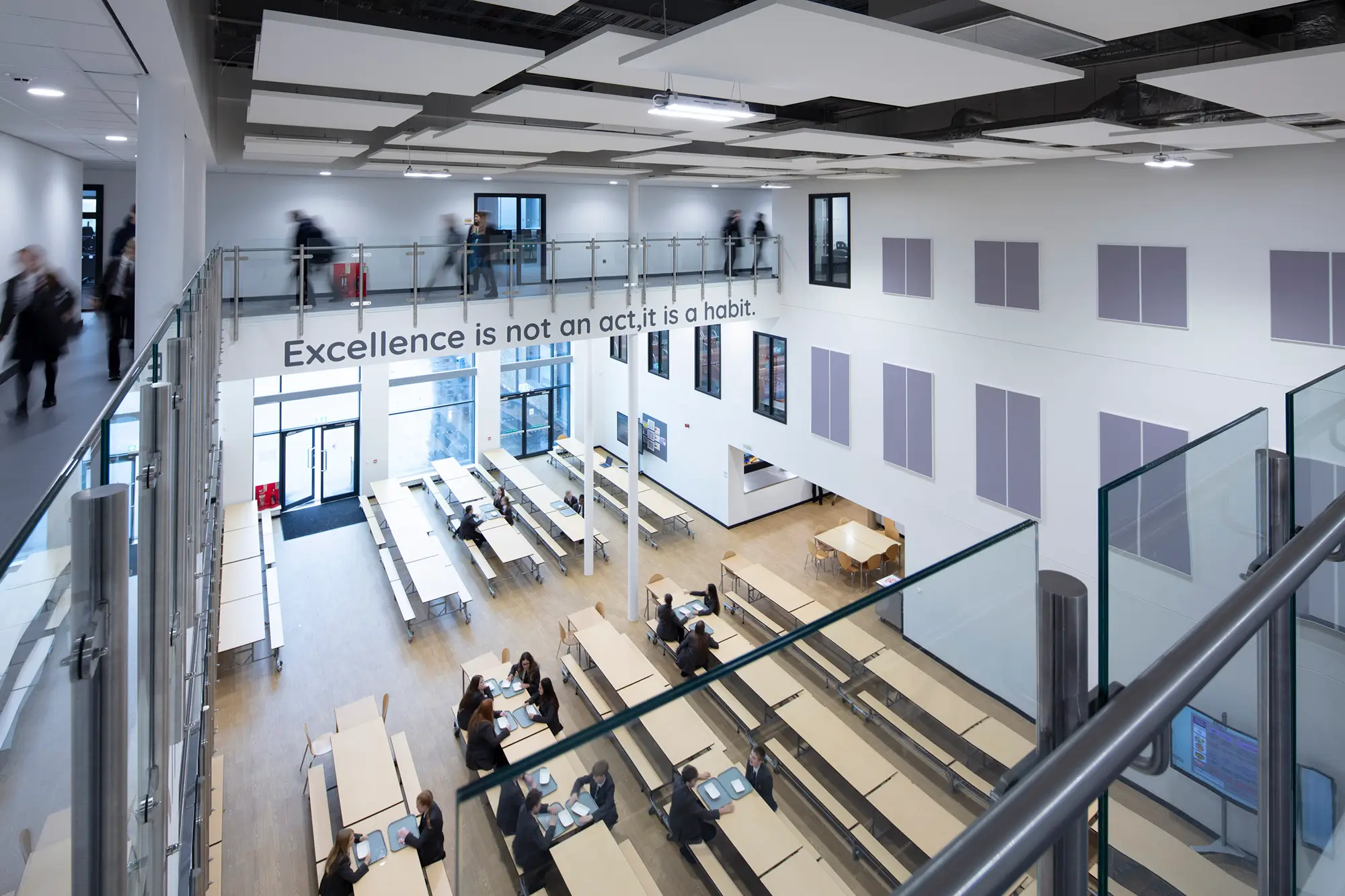
Materials were selected for their resilience and familiarity. Brick and metal reference the town’s architectural character without imitation. Internally, acoustic comfort and visual clarity guide the palette, creating an environment where students can focus and staff can teach without distraction.
Energy efficiency and environmental performance were integrated from the first sketches. The building’s thermal envelope, passive ventilation strategy and use of cross-flow air movement reduce energy demand and improve comfort. Air-source heat pumps provide heating and support passive cooling, reducing reliance on carbon-intensive systems. The biodiverse roof creates habitats for birds and insects while concealing a photovoltaic array that generates on-site renewable energy. Smart metering and a central building management system allow performance to be monitored and refined in real time.


Result
The completed school is a place where environmental responsibility, community value and educational ambition come together. The design has improved the rhythm of the school day, strengthened pastoral visibility and provided classrooms that feel bright, spacious and uplifting. Teaching spaces are adaptable, rooms are tailored to their subjects, and circulation has been designed to prevent bottlenecks. Deputy Headteacher Danny Morgan adds, “There are no pinch points. Transitions are calm. Students spend more time learning rather than walking between classes.”
Woodham Academy now operates as both an educational facility and a community hub. The swimming pool, auditorium and sports facilities support daily school use and are open to the public in the evenings, reinforcing the academy’s civic role. Landscaped paths connect the site to nearby green corridors, and the arrangement of outdoor spaces encourages students to spend time outside and return to class refreshed.
Woodham Academy stands as an example of what contemporary school design can achieve when stakeholder collaboration, environmental responsibility and community benefit are given equal weight.


People
"You can feel that it has been designed with people in mind.”The design grew from sustained engagement with the people who would use the building every day. Staff contributed directly to how departments were arranged and how teaching spaces should feel. Specialist rooms such as science labs, art studios and music suites were developed in close conversation with subject leads. As the school team described, “The design process always felt like a partnership. Every time we asked if something could work differently, the architects found creative solutions.”
Glazed screens allow passive supervision throughout the building, supporting safety while maintaining openness. Pastoral rooms and small-group areas are distributed across all floors so that support is never far away. Corridors are wide, bright and easy to navigate, giving students confidence in their environment.
Accessibility shaped every stage of the design. Level thresholds, wide entrances and dedicated parking ensure the building is welcoming to all. Secure boundaries are managed through subtle landscape and fencing strategies that keep students safe without separating the school from its neighbourhood.
“It is a real privilege to work in a building like this. You can feel that it has been designed with people in mind.”
Danny Morgans
Deputy Headteacher
Planet
Environmental performance is part of the building’s DNAWoodham Academy meets Net Zero Carbon in Operation standards through a combination of passive design, low-energy systems and active renewable generation. Environmental performance is part of the building’s DNA.
Orientation responds to local wind patterns, allowing fresh air to move naturally through the building. The thermal envelope works hard, supported by high-performance glazing and materials that maintain comfort with minimal energy use. Air source heat pumps deliver efficient heating and help stabilise temperatures year-round.
The green and biodiverse roof strengthens local ecosystems and supports pollinators. Photovoltaic panels within the roof generate clean electricity for the school, and smart metering provides detailed energy data that empowers informed management. The building is designed to remain resilient in a warming climate, capable of performing in conditions that exceed current norms.
Sustainability is not expressed as a feature. It is embedded in how the building works, how it feels and how it prepares students to understand the importance of environmental responsibility. As one teacher noted, “Students can now learn from real examples every day. Sustainability has become visible.”
Place
"It has become a symbol of pride for the town.”Woodham Academy sits confidently within its residential setting, with an architectural language that respects local character while establishing a uniquely modern identity.
The arrangement of entrances encourages arrival on foot and by bike. Landscaped routes connect to established green corridors, making the school part of a wider network of community spaces. Outdoor sports areas, planting and social spaces extend the educational experience beyond the classroom, giving students opportunities to engage with nature throughout the day.
Public-facing facilities such as the swimming pool and auditorium are placed for easy access, ensuring the campus supports community life without compromising school security.
“This place will benefit many generations of those living in Newton Aycliffe. It has become a symbol of pride for the town.”
Danny Morgans
Deputy Headteacher
Credits
- End User Eden Learning Trust (Woodham Academy)
- Project Lead Paul Broadfoot
- Design Team Apex Acoustics, BGP, Desco, SPACE
- Contractor Galliford Try
- Photography Andrew Hepinstall


